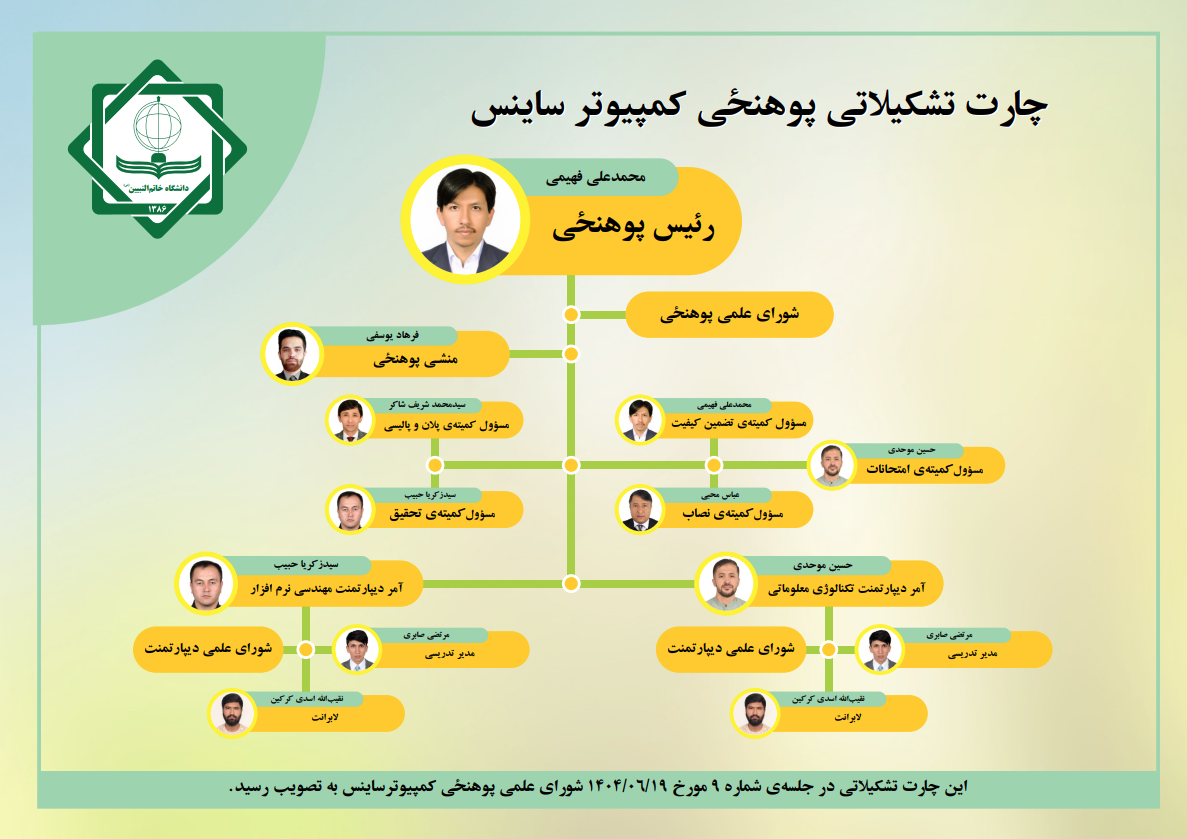
Computer Science Faculty

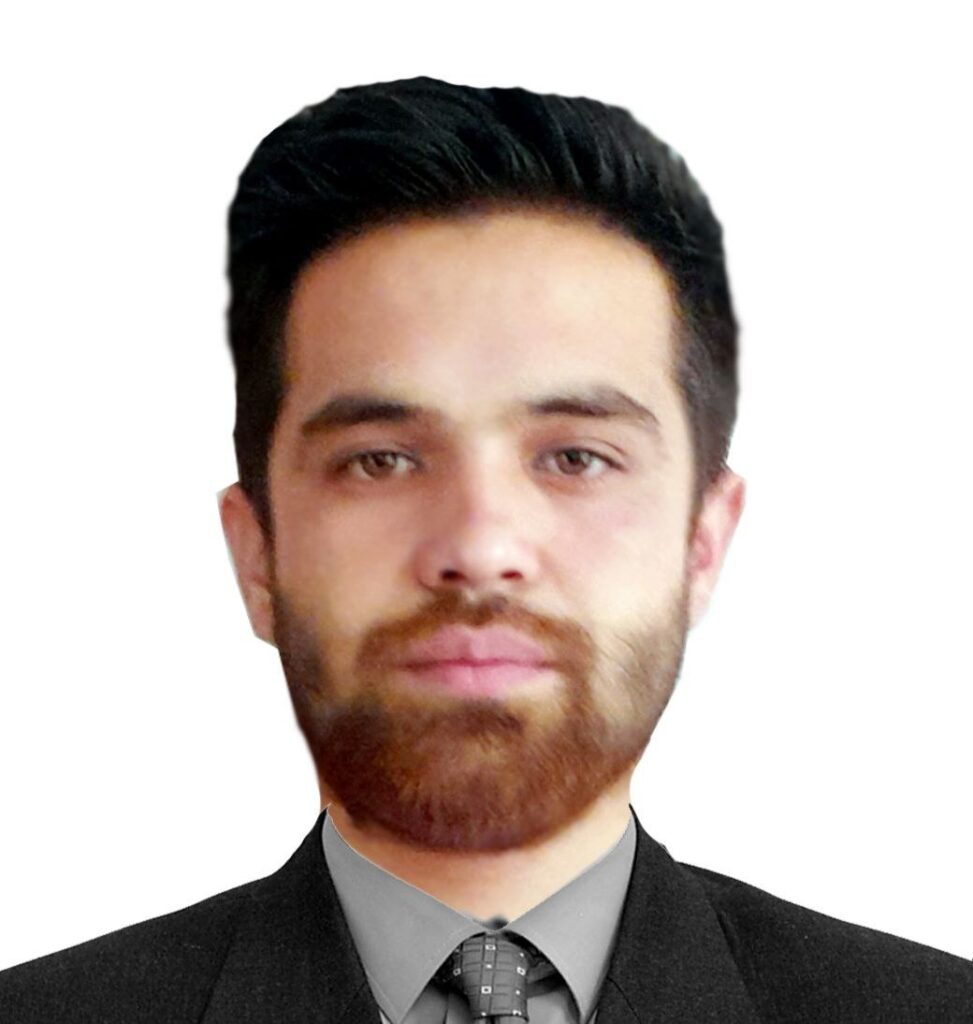
Mr. Mohammad Ali Fahimi

Educational Background:

  1. Master’s Degree in Information Technology Engineering from the University of Tehran in 2016 (corresponding to 1395);
  2. Bachelor’s Degree in Computer Engineering (Software Engineering) from Qom University, 2013 (corresponding to 1392);
  3. High School Diploma from Imam Sadeq High School (Mathematics–Physics), Qom, 2005 (corresponding to 1384).

Academic Background:

  1. Teaching Computer Science at Khatam al-Nabieen University (PBUH) from 2015 to present;
  2. Teaching Computer Science at Goharshad University from 2020 to present;
  3. Teaching Computer Science at Gharjistan University from 2015 to 2019;

Work Experience:

  • Dean of the Faculty of Computer Science, Khatam al-Nabieen University (PBUH), from Fall 2025 to present;
  • Head of the Information Technology Department from Spring 2024 to Fall 2025;
  • Dean of the Faculty of Computer Science at Khatam al-Nabieen University (PBUH) from 2018 to 2020;
  • Head of the Software Engineering Department from 2020 to 2022;
  • Responsibility in various faculty committees as required (Examinations Committee, E-Learning Committee, Curriculum Committee, etc.).

Scientific and Research Activities:

  • A study on the application of e-commerce in the development of dried fruit exports in Afghanistan (2016)
  • Application of E-commerce in Export Development (Quarterly Journal of Technical Sciences, Khatam al-Nabieen University (PBUH), Winter 2018);
  • Managing Director of the Technical Sciences Quarterly Journal, Khatam al-Nabieen University (PBUH), from 2018 to 2020.
  1. To effectively represent the faculty at the higher levels of the university and before external institutions and stakeholders;
  2. To formulate appropriate proposals and strategic plans for improving the academic and administrative performance of the faculty;
  3. To provide constructive recommendations to the Academic Vice Chancellor for the enhancement of academic, administrative, and executive affairs;
  4. To supervise the implementation of laws, regulations, bylaws, and resolutions of the Faculty Academic Council and university councils;
  5. To convene and chair Faculty Council meetings and forward approved resolutions to the relevant authorities for implementation and legal processing;
  6. To oversee the academic and educational activities of the departments;
  7. To supervise undergraduate final research projects and Master’s theses;
  8. To oversee the review and revision of the academic curriculum and submit recommendations to the university’s central committee;
  9. To establish academic, research, and capacity-building collaborations with reputable external academic institutions;
  10. To strive for the continuous improvement of teaching quality and the adoption of the latest academic developments in education;
  11. To foster a cooperative and collegial environment among faculty members and ensure student satisfaction as the university’s primary stakeholders;
  12. To supervise all programs and activities of the faculty’s subcommittees;
  13. To collect, consolidate, and review reports submitted by faculty committees;
  14. To evaluate the reports and activities of committees and departments and provide appropriate solutions where necessary;
  15. To formulate and implement the faculty’s five-year strategic plan;
  16. To receive monthly reports from the relevant departments regarding the academic and teaching activities of faculty members;
  17. To design, manage, and organize academic seminars approved by the relevant Academic Council;
  18. To direct and administer the faculty’s research affairs;
  19. To communicate and implement decisions and directives issued by higher authorities to the departments;
  20. To participate in official meetings and external sessions when required and upon the instruction of the Academic Vice Chancellor;
  21. To provide feedback to the respective department heads;
  22. To supervise the updating of curricula in accordance with societal needs and recommend revisions when necessary;
  23. To submit comprehensive semester-based and annual reports on all faculty activities to the academic vice chancellor;
  24. To implement the faculty’s annual monitoring program and ensure its timely submission to the academic vice chancellor;
  25. To perform other lawful duties assigned by the higher authorities.

The Faculty of Computer Science at Khatam al-Nabieen University (PBUH) was established in 2011 with the official authorization of the Ministry of Higher Education of the Islamic Republic of Afghanistan. The faculty was founded with the aim of training skilled professionals in the following fields:

  1. Software Systems Development and Management;
  2. Design, implementation, and management of computer networks at various levels;
  3. Design, development, and management of information systems (databases);
  4. Implementation of web page projects and teaching various programming languages;
  5. Keeping up with the latest science and technologies in the field of computer science;

This faculty consists of two departments: Software Engineering and Information Technology. In the academic programs of the Software Engineering Department, particular emphasis is placed on training skilled and professional personnel who possess the relevant scientific and technical competencies in this field. Both the Software Engineering and Information Technology departments are active in this faculty.

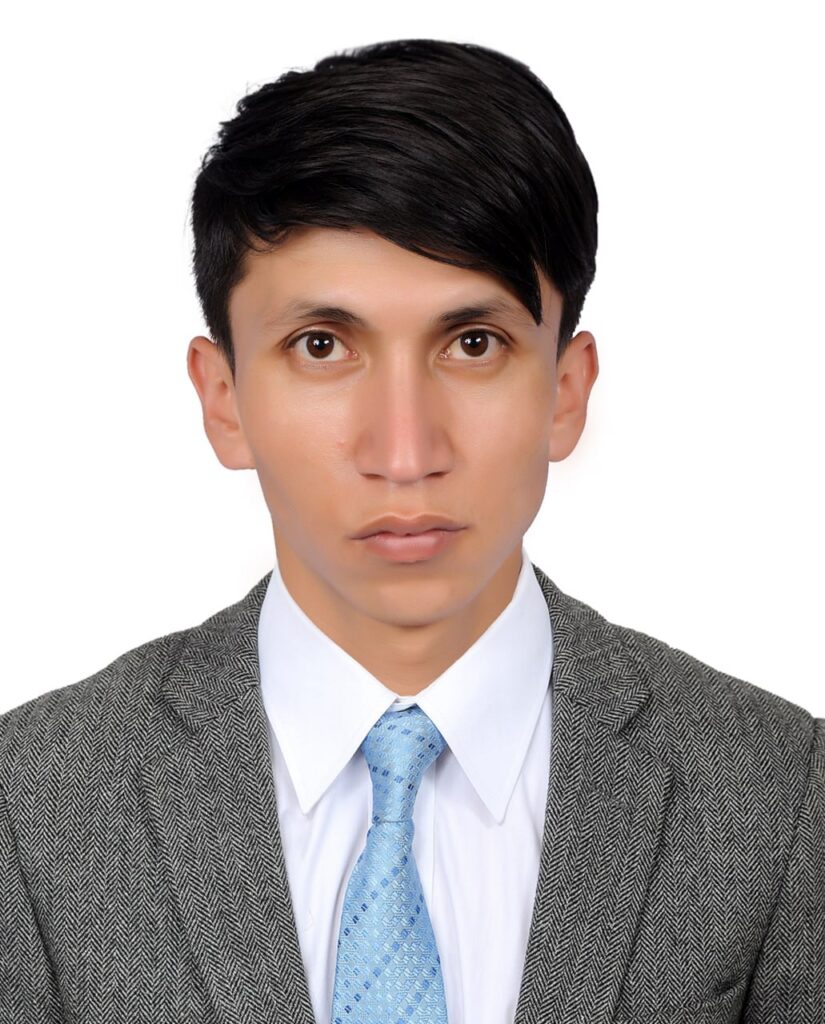
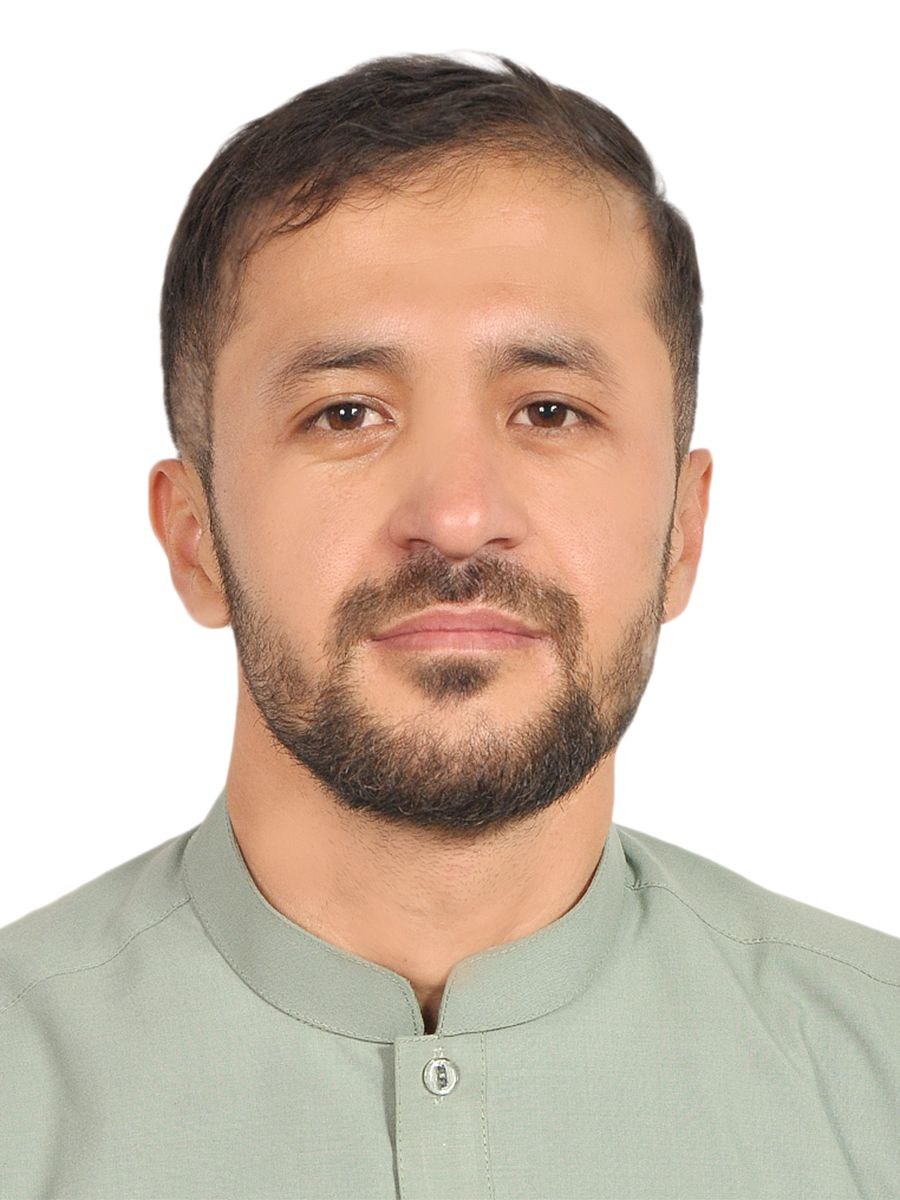
Head of the Information Technology Department

Mr. Hussain Mowahedi

Educational Background:

  • Master’s Degree in Computer Networks from Amirkabir University of Technology (Tehran Polytechnic) – 2024;
  • Bachelor’s Degree in Computer Science from Bamyan University – 2017;
  • High School Diploma from Abdul Rahim Shaheed High School, Kabul – 2013;

Academic Experiences:

  • Lecturer in the Information Technology Department, Khatam Al-Nabieen University (PBUH), from 2023 to present;
  • Lecturer in the Information Technology Department, Avicenna University, Kabul – 2024;
  • Lecturer in the Information Technology Department, Esteqlal Institute of Higher Education, 2020–2021 and 2023;
  • Lecturer at ZoomByte Institute of Information Technology, 2019–2020;

Work Experience:

  • Dean of the Faculty of Computer Science, Esteqlal Institute of Higher Education, 2023;
  • Head of Information Technology at Al-Mustafa University, Kabul, 2018–2021;
  • IT Manager at Gholghola Hotel, Bamyan, 2017;
  • IT Intern, Bamyan University, 2016;

Online Skills and Certifications

  • CCNP-Encore certified;
  • MCSE certified;
  • MTCNA Certified;
  • VMware ESXi certified;
  • Veeam Backup certified;
  • ASA, Pfsense, Kerio Control Certified;
  • Linux Administration (LPIC1 & LPIC2).

The Department of Information Technology is one of the academic programs of the Faculty of Computer Science. The Faculty of Computer Science at Khatam Al-Nabieen University (PBUH) was established in 2011 with the official authorization of the Ministry of Higher Education of Afghanistan and began admitting students in the spring of the same year. This department, by utilizing experienced lecturers, well-equipped laboratories, a curriculum aligned with the labor market, and standard classrooms, provides educational and research services to students in this field in line with advancements in information technology.
The department has successfully graduated eight cohorts of students. Its graduates possess skills in computer network design and support, network programming, and software design and development. The classrooms are equipped with appropriate teaching spaces and standard educational technologies. The specialized Cisco laboratory contains modern networking equipment such as routers, switches, access points, and other essential devices for network design. A public library with a dedicated section for the department’s courses is also located within the university building. Furthermore, the department has two full-time academic staff members and several contractual lecturers for the implementation of both practical and theoretical courses.

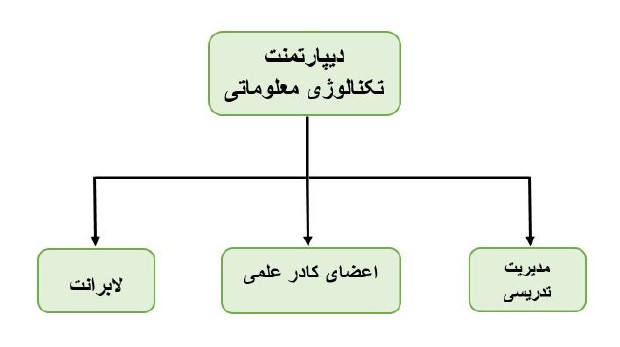
Organizational Structure of the Department

The organizational structure of the department includes the Department Headship, members of the Academic Council, the Teaching Manager, and laboratory technicians, as shown in the chart below.
Achievements

The achievements of the Information Technology Department are presented below.
  1. Training of dozens of committed and specialized bachelor’s degree students;
  2. Publication of several scientific articles in international journals and internal university publications;
  3. Updating the department’s curriculum in accordance with labor market requirements;
  4. Equipping Cisco laboratories and conducting practical and laboratory courses;
  5. Utilization of qualified and experienced lecturers holding Master’s and PhD degrees;
  6. Improvement in both the quantity and quality of educational services;
  7. Organizing seminars and workshops to enhance the capacity of faculty members, staff, and students;
  8. Utilization of the opinions of faculty members, staff, and students in planning and decision-making;

Vision

The Department of Information Technology strives, through the provision of quality education and standardized research, to become one of the best Information Technology departments in the country by 2027.

Mission

The Department of Information Technology, with specialized and experienced faculty members and modern equipment, operates through quality education and standard research to train committed and professional human resources.

Department Values

The Information Technology Department is one of the active programs of the Faculty of Computer Science and, like other programs, has defined values that are explained below. The department’s values consist of its overall strategic objectives. These objectives are aligned with the general goals of the Ministry of Higher Education of the Islamic Emirate of Afghanistan.

Strategic Objectives of the Department

  1. Development of research, knowledge production, and innovation;
  2. Administrative reform and system development, good governance, and combating administrative corruption;
  3. Review and development of curricula;
  4. Ensuring the implementation of quality assurance and accreditation standards in higher education institutions;
  5. Development and improvement of e-learning;
  6. Development and improvement of infrastructure;
  7. Enhancement of capacity
  8. Review, amendment, and formulation of legislative and technical documents;
  9. Improvement and development of relations with academic and non-academic institutions;
  10. Equitable access to higher education;
  11. Development and improvement of society;

The overall objectives of the department have been defined in line with the objectives of the Faculty of Computer Science at Khatam Al-Nabieen University (PBUH) and the Ministry of Higher Education of Afghanistan. However, considering the nature of the department, some of the above-mentioned items, such as reviewing, amending, and drafting legislative and technical documents, do not fall within the scope of this department and have therefore not been included.

  1. Plan, organize, and chair departmental meetings;
  2. Monitor the implementation of theoretical and practical course curricula and submit semester reports to the faculty;
  3. Manage all educational, administrative, and operational processes of the department;
  4. Prepare semester and annual academic plans;
  5. Propose measures for improving departmental academic and administrative operations;
  6. Address departmental;
  7. advise the Dean on educational and administrative improvements;
  8. Monitor students’ academic performance, compliance with regulations, course registration, attendance, examinations, monographs, and graduation procedures;
  9. Recommend recognition and awards for faculty demonstrating excellence in teaching and research;
  10. Maintain faculty academic files and record teaching and research activities semester-wise;
  11. Organize student enrichment activities (e.g., reading competitions, academic trips, and essay contests) and maintain documentation;
  12. Identify and follow up on educational and administrative departmental needs;
  13. Conduct teaching quality evaluations and prepare corresponding reports;
  14. Manage Bachelor’s theses and Master’s dissertations (topic selection, distribution, supervision, and review);
  15. Participate in faculty teaching assessments and report to the Faculty Council;
  16. Conduct departmental quality enhancement meetings and document resolutions;
  17. Preparing and submitting semester-based and annual reports on all departmental activities to the Dean’s Office of the Faculty;
  18. Preparing annual monitoring reports and periodic reviews of the relevant academic program in collaboration with the panel committee;
  19. Participate in official meetings, including external events, as directed by the Dean;
  20. Oversee contractual faculty activities;
  21. Recommend faculty recruitment and follow the legal procedures;
  22. Perform other lawful duties as assigned.

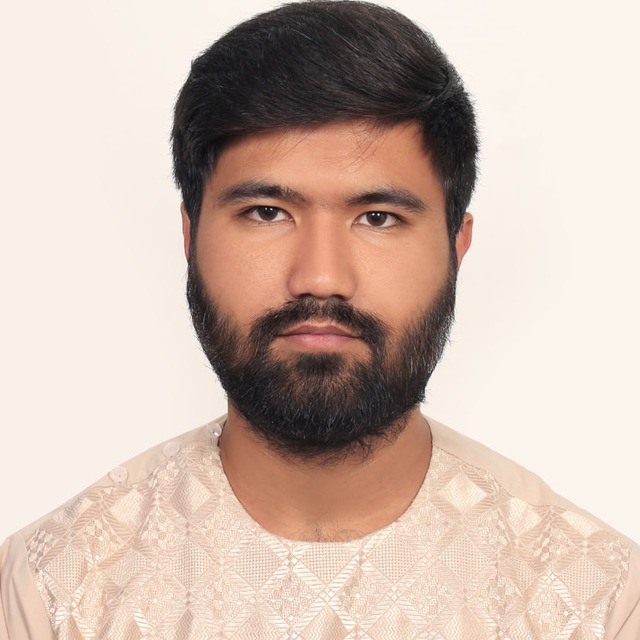
Head of the Software Engineering Department

Mr. Sayed Zakaria Habib

Educational Background:

  1. Master’s Degree in Information Systems and Security from Sakarya University, Turkey, 2018;
  2. Bachelor’s Degree in Computer Science from Kabul Polytechnic University, 2011;

Academic Background:

  • Managing Director of the Technical Sciences Quarterly Journal, Khatam Al-Nabieen University (PBUH), from Spring 2024 to present;
  • Specialized Lecturer at Khatam Al-Nabieen University (PBUH), from 2022 to present;
  • Specialized subject lecturer and Dean of the Faculty of Computer Science at Dunia University from 2020 to 2022;
  • Specialized Lecturer at Esteqlal Institute of Higher Education from 2018 to 2020;

Work Experience:

  • Head of the Software Engineering Department, Faculty of Computer Science, Khatam Al-Nabieen University (PBUH), for nearly three years;
  • Dean of the Faculty of Computer Science at Dunia University for two and a half years;
  • Intern and Research Member at the University of Oviedo, Spain;
  • Execution of public projects for more than two years in development projects;
  • Information Systems Support Specialist and Engineer at MTN Telecommunications Company for more than three years;
  • System Designer and Programmer at Chiragh Hospital for more than one year;
  • Technical and Engineering Consultant in telecommunications companies;

Academic Works:

  • Completion of Master’s thesis in the field of security and security strategy;

What is rapidly and continuously evolving in today’s modern world is technology, under which the development of information systems, software engineering, software project management, data storage, and efficient data processing takes place. On the other hand, it is undoubtedly human needs that drive constant innovation and technological transformation at every moment.
Based on these needs, humans continuously adapt themselves to this evolutionary process in order to enhance their knowledge and accelerate the use of technology. Academic institutions, especially those in the field of technology and information science worldwide, continuously review and update their curricula and academic programs in accordance with time and place requirements.
To achieve such a process and create an environment of innovation, the Software Engineering Department has also followed this path and started its activities within the academic framework of Khatam Al-Nabieen University (PBUH). The most important aspect of this department’s academic programs is the training of skilled and professional human resources who are capable both in management and technical domains, enabling them to meet labor market demands and contribute to personal and societal development.
Since the Faculty of Computer Science at Khatam Al-Nabieen University (PBUH) obtained its license from the Ministry of Higher Education in 2011, it has been operating within the regulations of the ministry and the university. The Software Engineering Department, as one of its departments, began its practical and applied activities in 2016.
This department has graduated several cohorts of students and achieved remarkable results. Currently, it employs qualified lecturers at the master’s level and implements a standard curriculum to attract and educate students in the field of software engineering.
Students complete a four-year program (eight semesters) and graduate with a bachelor’s degree. Graduates can work in areas such as design, development, information systems management, system security and databases, web-based system development, mobile application development, software programming, and software project management. This program also prepares graduates for working with artificial intelligence and continuing higher education in all related fields without difficulty.
Currently, the department functions as an independent and degree-granting academic unit. Among its achievements are the design and modeling of intelligent systems, modeling and implementation of efficient information systems, and the management of such systems.

Educational Facilities

The Software Engineering Department has grown and developed in various academic and practical fields since its establishment and has worked toward achieving its specific objectives, succeeding in empowering students and learners. The department is equipped with the following educational facilities and resources to provide academic services.

  1. Equipped and standard classrooms with installed monitors and wall-mounted boards;
  2. Providing internship opportunities for current students and graduates of this field in national companies and government institutions;
  3. Use of an information system for student management and recording the academic activities of faculty members and students;
  4. Having a well-equipped laboratory for curriculum implementation, software system development, and programming;
  5. Availability of a library and its necessary facilities at the university level;
  6. Availability of an Internet club for student use;

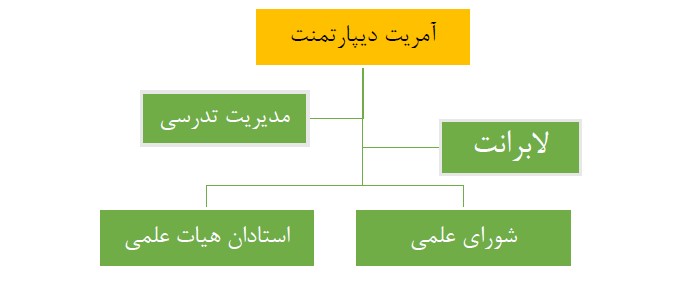
Organizational Structure of the Department

The organizational structure of the department consists of the Department Headship, academic staff members, teaching management, and laboratory technicians, in which the Academic Council holds executive and academic authorities.
Achievements

The Software Engineering Department, in order to provide better services to citizens and students, has been able to achieve the following accomplishments since its establishment to the present.

  1. The establishment of the Software Engineering program is one of the most important and fundamental achievements.
  2. In the field of knowledge production and dissemination in computer science, as well as institutionalizing the culture of software usage and related knowledge, this is the most important achievement of the department.
  3. Having specialized and experienced lecturers at Master’s level and PhD candidates;
  4. Training and graduation of professional students at the bachelor’s level;
  5. Publication of several scientific articles in international journals and internal university publications;
  6. Institutionalization of research;
  7. Achieving practical class projects in the field of hardware setup;

Vision

The Software Engineering Department strives to provide the best educational services, standard research, and the development of practical software in order to be recognized as one of the best Software Engineering departments in the country by 2027.

Mission

The Software Engineering Department, with specialized and competent faculty members and adequate facilities, strives to provide high-quality education and standardized research in order to prepare the best skilled workforce required by the country.

Values

  • Preservation of Islamic, national, and academic independence values;
  • Respect for academic freedoms and human dignity;
  • Empowerment and training of the workforce required by society;
  • Specialization and knowledge orientation;
  • Social responsibility and work effectiveness;
  1. Plan, organize, and chair departmental meetings;
  2. Monitor the implementation of theoretical and practical course curricula and submit semester reports to the faculty;
  3. Manage all educational, administrative, and operational processes of the department;
  4. Prepare semester and annual academic plans;
  5. Propose measures for improving departmental academic and administrative operations;
  6. Address departmental;
  7. advise the Dean on educational and administrative improvements;
  8. Monitor students’ academic performance, compliance with regulations, course registration, attendance, examinations, monographs, and graduation procedures;
  9. Recommend recognition and awards for faculty demonstrating excellence in teaching and research;
  10. Maintain faculty academic files and record teaching and research activities semester-wise;
  11. Organize student enrichment activities (e.g., reading competitions, academic trips, and essay contests) and maintain documentation;
  12. Identify and follow up on educational and administrative departmental needs;
  13. Conduct teaching quality evaluations and prepare corresponding reports;
  14. Manage Bachelor’s theses and Master’s dissertations (topic selection, distribution, supervision, and review);
  15. Participate in faculty teaching assessments and report to the Faculty Council;
  16. Conduct departmental quality enhancement meetings and document resolutions;
  17. Preparing and submitting semester-based and annual reports on all departmental activities to the Dean’s Office of the Faculty;
  18. Preparing annual monitoring reports and periodic reviews of the relevant academic program in collaboration with the panel committee;
  19. Participate in official meetings, including external events, as directed by the Dean;
  20. Oversee contractual faculty activities;
  21. Recommend faculty recruitment and follow the legal procedures;
  22. Perform other lawful duties as assigned.

Charter of the Subcommittee for Curriculum

Introduction

The curriculum serves as a comprehensive reflection of the educational system, encompassing the foundational and most prominent documents and experiences of academic programs. It not only presents the content and subjects of instruction but also clarifies the structure, duration, and credit allocation of courses. Moreover, it captures the educational experiences and learning outcomes and serves as a standard for assessment, evaluation, and accreditation. To achieve these objectives, the Subcommittee for Curriculum has been established within the faculty.

Basis

This charter is formulated based on Article 14 of the Civil Higher Education Law and Article 33 of the University Statute.

Objectives

  • Enhance the content and structure of courses;
  • Align the curriculum with the academic, practical, and societal needs of the country;
  • Ensure the curriculum reflects advancements in knowledge and applicable skills;
  • Facilitate more effective and objective evaluation of educational content and learning outcomes.

Structure and Membership

  • The Subcommittee for Curriculum operates within the faculty structure;
  • Membership comprises at least three faculty members (with additional members from the faculty as needed);
  • The term of membership is one year, with eligibility for renewal;
  • Members elect one experienced faculty member as Chair through a confidential direct vote.

Quorum

  • Meetings are considered official with a majority of members present;
  • Approvals and decisions are made by an absolute majority of the members present in the official meeting.

Duties and Responsibilities

In accordance with Article 14 of the Civil Higher Education Law and relevant higher-level regulations, the Subcommittee for Curriculum is tasked with the following:

  • Conduct semester-wise reviews of existing courses and propose revisions to the faculty to ensure alignment with legal provisions, academic and social needs, and labor market requirements;
  • Review and propose amendments to educational needs assessment questionnaires prepared by the departments;
  • Continuously monitor the implementation of approved course syllabi, materials, and resources within departments and the faculty;
  • Oversee the development, distribution, and implementation of policy courses and recommend improvements to the relevant department;
  • Develop operational plans, measures, and other necessary programs for the committee;
  • Organize meetings according to the pre-established calendar (at least once per month) and maintain standardized records of all decisions and recommendations;
  • Propose additions, deletions, substitutions, or rearrangements of courses to the faculty;
  • Review and provide feedback on newly proposed curricula submitted by departments;
  • Collaborate with the curriculum evaluation team for periodic curriculum review;
  • Collect and maintain standardized records and documentation related to the curriculum;
  • Prepare and submit semester and annual reports to the faculty in a timely manner.

Charter of the Subcommittee for Research

Basis


The Faculty Research Subcommittee is established in accordance with Chapter Two, Article 33, Note 1 of the University Statute.

Objectives

  • Enhance research activities within the faculty;
  • Provide research opportunities for faculty members and students;
  • Organize research projects to achieve meaningful and high-quality outcomes;
  • Facilitate the development of research capacities for both faculty and students.

Article 1: Membership

  • The Faculty Dean, together with a faculty member selected by the Faculty Academic Council;
  • At least two faculty members, appointed by the Faculty Academic Council;
  • One student, appointed by the Faculty Academic Council.

Clause 1: Students eligible for membership must

  • Have the highest academic standing in their cohort;
  • Be ethically and morally approved;
  • Have completed at least half of their academic program;
  • Possess certain research skills.

Clause 2: Faculties offering Master’s programs may include one student from the Master’s level as a committee member, in addition to the undergraduate student, selected by the Faculty Academic Council.

Article 2:

The term of office for committee members is one year.

Article 3:

The Research Subcommittee meets regularly at least once per month.

Article 4: Responsibilities

  • Develop and implement the faculty’s annual research program;
  • Facilitate research opportunities for faculty members and students;
  • Propose new and significant research topics for students each semester;
  • Organize research capacity-building courses at the faculty level;
  • Conduct student research competitions on specialized topics;
  • Recommend selected student theses for publication as books through the University Research Council;
  • Establish research collaborations with national and international institutions related to the faculty;
  • Organize academic seminars at both faculty and university levels.

Charter of the Subcommittee for E-Learning

Article 1: Basis

The Subcommittee for E-Learning is established in accordance with Article 33, Clause (c) of the University Statute.

Article 2: Objectives

  • Enhance the effectiveness of the university’s e-learning programs;
  • Strengthen and develop scientific and technological capacities in e-learning;
  • Promote and improve the infrastructure for e-learning;
  • Clarify the roles and responsibilities of the main committee and the subcommittees for e-learning.

Article 3: Membership

  • Members of the Subcommittee for E-Learning are selected by the Faculty Academic Council for a one-year term and submitted through the relevant office to the Academic Vice Chancellor for approval;
  • Membership may be renewed with the approval of the respective faculty;
  • Meetings are held monthly according to a pre-determined calendar.

Article 4: Duties and Responsibilities of the E-Learning Subcommittee

    • Prepare operational plans, initiatives, and other necessary programs of the subcommittee, considering relevant indicators;
    • Develop and approve the subcommittee’s meeting calendar and conduct meetings accordingly;
    • Implement and follow up on resolutions of both the subcommittee and the main e-learning committee in a timely manner;
    • Propose guidelines and plans for e-learning to advance related activities and present them to the faculty;
    • Ensure that the Subcommittee Chair is a member of the Main E-Learning Committee;
    • Promote and manage e-learning activities within the faculty;
    • Evaluate the e-learning content of faculty members in accordance with established standards;
    • Collect, maintain, and archive all documents and evidence relevant to the subcommittee;
    • Prepare semester and annual performance reports of the subcommittee and submit them to the faculty.

Charter of the Subcommittee for Quality Enhancement

Article 1. Basis


The Charter of the Subcommittee for Quality Enhancement is formulated in accordance with Article 18 of the Quality Assurance and Accreditation Regulations of the Ministry of Higher Education, the charter of the Main Committee, and the University Statute.

Article 2: Objectives

  • Institutionalize the quality enhancement process within the relevant domain and uphold the university’s academic credibility in this area;
  • Ensure compliance with university regulations, bylaws, and policies.

Article 3. Structure and Membership

The Subcommittee for Quality Enhancement operates under the Dean of the Faculty and comprises the following members:

  • The Dean of the Faculty, serving as the subcommittee chair;
  • Heads of the relevant departments, serving as members;
  • Membership in the subcommittee is for a one-year term, renewable without restriction;
  • A minimum of three full-time faculty members must be part of the subcommittee.

Article 4. Quorum

  • A meeting of the subcommittee is considered valid with the presence of the majority of members;
  • Decisions are adopted by an absolute majority of the members present;
  • Meetings are held at least once a month according to a pre-determined calendar. Extraordinary meetings may be convened when necessary, with a formally announced agenda.

Article 5. Responsibilities of the Committee

  • Approve the subcommittee’s meeting calendar;
  • Review and approve the subcommittee’s operational plans;
  • Examine and approve quarterly and annual reports of the subcommittee;
  • Provide guidance on the formulation of quality enhancement programs;
  • Oversee all academic, administrative, teaching, and research activities of the faculty and affiliated units;
  • Conduct inspections of activities through a designated panel and submit reports to the Faculty Academic Council;
  • Approve the inspection reports on quality enhancement activities submitted by the panel;
  • Encourage, facilitate, and provide advisory support for improving quality at the faculty level;
  • Conduct a Self-Assessment (SA) of relevant academic programs and formally submit the results to the Main Committee after approval by the Faculty Academic Council.

Charter of the Subcommittee on Order and Discipline

Article 1: Basis

This charter is established pursuant to Clause 3, Item 2 of Article 60 of the Civil Higher Education Law, enacted in Qaws 1396 (2017/2018), and in accordance with Article 33, Part 1 of the Statute of Khatam al-Nabieen(PBUH) University. The subcommittee is created to ensure the regular and orderly continuation of academic and administrative activities and to prevent potential misconduct or deviations within the university.

Article 2: Objectives

  • Ensure order and discipline within the faculty;
  • Monitor adherence to rules and discipline across the faculty;
  • Establish and maintain a safe and calm environment;
  • Promote mutual respect among students, faculty, and staff;
  • Foster Islamic ethics and adherence to core Islamic principles among students;
  • Cultivate a sense of personal responsibility among students;
  • Address complaints and suggestions within the faculty;
  • Submit reports on all activities conducted at the faculty level.

Article 3: Structure and Composition

The Subcommittee on Order and Discipline consists of:

Chair: Dean of the faculty;
Members: Two faculty members appointed by the Faculty Council;
Secretary: Administrative or teaching officer of the faculty.

Note: The term of service for the committee is one year.

Article 4: Meeting Validity and Approval Procedure

  • Meetings are considered official with a majority of members present;
  • Committee members may be replaced after one year;
  • Meetings are held once per month;
  • Decisions require an absolute majority of members present.

Clause: In urgent situations requiring immediate attention, extraordinary meetings may be called at the discretion of the chair.

Article 5: Duties and Responsibilities

  • Develop the faculty-level operational plan aligned with the university’s main committee plan;
  • Establish a regular monthly meeting calendar;
  • Address complaints from students, faculty, and staff;
  • Engage all relevant parties in resolving identified issues;
  • Monitor the implementation of disciplinary regulations as outlined in the university’s disciplinary committee charter;
  • Review exam-related violations referred by the Examination Committee;
  • Refer cross-faculty cases to the university’s main Subcommittee on Order and Discipline.
  • Handle security-related violations within the faculty;
  • Address misuse of academic work and intellectual property;
  • Investigate violations such as document forgery or academic cheating;
  • Maintain a disciplinary record book at the faculty level;
  • Establish a complaints and suggestions box;
  • Conduct orientation sessions for new students on the faculty’s code of ethics;
  • Submit monthly and semester reports on committee activities to the university’s main committee on order and discipline.

Article 6: Disciplinary Measures

  • The faculty implements disciplinary measures for students through the Subcommittee on Order and Discipline.
  • Potential sanctions include the following:
    • Verbal warning;
    • Written warning;
    • Suspension from attending a single lecture;
    • Suspension from a course for three weeks;
    • Temporary expulsion;
    • Permanent expulsion;
    • Compensation for damages.

Clause: Measures 1–4 are implemented based on the committee’s decisions, while measures 5–7 require recommendation by the subcommittee and approval by the University Supreme Council.

Charter of the Subcommittee for Cultural Affairs

Article 1: Basis

This charter is established pursuant to Articles 41–44 of the University Statute, the Main Cultural Committee’s Duties Charter, and the new framework provided by the Ministry of Higher Education.

Article 2: Objectives

  • Enhance the religious and national commitment within the university community;
  • Promote an environment of vitality, optimism, and hope on campus;
  • Institutionalize awareness among university members of religious role models, Islamic ethics, and nationally valued customs.

Article 3: Structure and Membership

  • The Subcommittee for Cultural Affairs is integrated within the faculty structure;
  • The chair and members are appointed by the Faculty Academic Council for a one-year term and are submitted to the University Administration for approval;
  • Committee membership may be renewed with the consent of the respective faculty;
  • Committee meetings are held once a month, according to a pre-established calendar.

Article 4: Duties and Responsibilities

The Subcommittee for Cultural Affairs is tasked with the following responsibilities to achieve the faculty’s objectives:

  • Develop and implement the operational plan, measures, and other programs required by the committee;
  • Prepare and approve the committee’s meeting calendar and conduct meetings accordingly;
  • Ensure the timely execution and follow-up of decisions made by both the Subcommittee and the Main Cultural Committee;
  • The Subcommittee Chair serves as a member of the Main Cultural Committee;
  • Propose and approve the programs and initiatives of the subcommittee;

  • Advanced cultural activities at the faculty level;
  • Collect and maintain standardized records and evidence related to the committee’s activities;
  • Prepare semester and annual performance reports and submit them to the relevant administrative office.

Charter of the Subcommittee for Planning and Policy

Article 1. Basis

This charter is drafted in accordance with Article 18 of the Quality Assurance and Accreditation Regulations of the Ministry of Higher Education, the Main Committee Charter, and the University Statute.

Article 2: Objectives

  • Institutionalize systematic planning and program implementation;
  • Ensure compliance with university regulations and timely execution of tasks;
  • Maintain and enhance the academic credibility of the faculty.

Article 3. Structure and Membership

The Subcommittee for Planning and Policy operates under the authority of the faculty dean and is composed as follows:

  • One faculty member appointed as the subcommittee head;
  • Heads of the relevant departments, serving as members;

Clause 1: The committee must have at least three members. Membership is for one year, with renewal permitted.

Article 4. Quorum

  • A meeting of the subcommittee is considered valid with the presence of the majority of members;
  • Decisions are adopted by an absolute majority of the members present;
  • Meetings are held at least once per month, according to a pre-determined calendar;
  • Extraordinary meetings may be called as necessary, with a formal agenda.

Article 5. Responsibilities of the Planning and Policy Committee

  • Approve the subcommittee’s meeting calendar;
  • Review and approve the subcommittee’s operational plans;
  • Examine and approve quarterly and annual reports of the subcommittee;
  • Provide guidance on program development and planning processes;
  • Monitor the preparation and implementation of operational plans and reports of the faculty and its affiliated units;
  • Approve consolidated monitoring reports on the execution of operational plans across the faculty and affiliated units;
  • Oversee the monitoring of all faculty activities through a designated board and submit reports to the Faculty Academic Council for approval;
  • Encourage, facilitate, and provide advisory support for improving quality at the faculty level;

List of Faculty Members

Networks PhD Candidate
No. Full Name Field of Study Academic Degree Academic Rank
1 Abbas Mohebbi Information Technology Master’s degree Assistant Professor
2 Sayed Mohammad Sharif Shakir Mathematics Master’s degree Associate Professor
3 Mohammad Ali Fahimi Information Technology PhD Candidate Assistant Professor
4 Sayed Zakaria Habib Information Systems and Security Master’s degree Assistant Professor
5 Hussain Mowahedi ComputerMaster’s degree Assistant Professor
6 Lotfullah Tofan Computer ScienceAssistant Professor

Associate of the Faculty of Computer Science

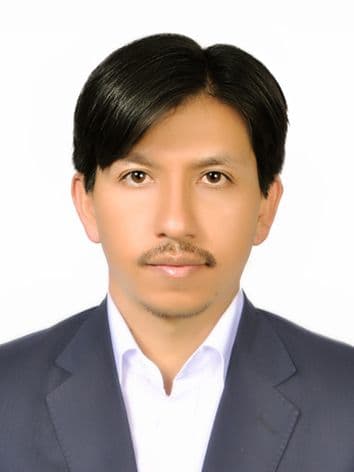
Mr. Farhad Yousefi

Educational Background:

  1. Bachelor’s Degree in Commercial Economics from Khatam Al-Nabieen University (PBUH), 2024;
  2. High School Diploma from Jabeebieh High School, Kabul, 2019;

Experience and Achievements:

  • Internship at the Faculty of Economics, Khatam Al-Nabieen University (PBUH), from Spring 2023 to Fall 2023;
  1. Collect and submit monthly faculty reports to the Office of Faculty Affairs;
  2. Prepare and circulate the Scientific Council meeting calendar
  3. Serve as a member and secretary of the Subcommittee on Order and Discipline;
  4. Communicate and follow up on decisions of the Scientific Council and subcommittees;
  5. Sort, distribute, and track correspondence, reports, and communications across faculty units;
  6. Maintain and archive documents, letters, and reports in designated locations;
  7. Schedule appointments with the Dean;
  8. Record and archive all incoming and outgoing correspondence;
  9. Monitor the faculty email account and report to the Dean;
  10. Provide assistance to visitors and faculty contact points;
  11. Actively participate in all quality assurance activities;
  12. Distribute official communications to higher-level offices and external stakeholders;
  13. Collect and review faculty dossiers and submit to the Office of Faculty Affairs;
  14. Develop and maintain a faculty database
  15. Perform other tasks assigned by the Dean.

Director of Teaching Affairs, Information Technology and Software Engineering Departments

Mr. Mortaza Saberi

Educational Background:

  • Bachelor’s Degree in Computer Science (Software Engineering) from Khatam Al-Nabieen University (PBUH), 2014–2018;

Work Experience:

  • Database Manager of the Library, Khatam Al-Nabieen University (PBUH), 2018–2021;
  • Master’s Board Manager, Khatam Al-Nabieen University (PBUH), 2021–2022;
  • Director of Teaching Affairs, Faculty of Computer Science, Khatam Al-Nabieen University (PBUH), 2022–present;
  1. Oversee student academic affairs, including semester registration, file creation, course selection, course add/drop, instructor assignment, deferment, course transfer, probation, graduation reporting, and academic performance monitoring;
  2. Schedule semester timelines, final exams, and exam cards;
  3. Track and report on student suspensions and probation per Article 34 of the Academic Regulations;
  4. Manage all matters related to Master’s theses and undergraduate final research projects;
  5. Recommend eligible students for internships in hospitals (for medical programs);
  6. Archiving all documents related to the student’s academic process in the student academic file;
  7. Archiving grade sheets, result tables, graduation records, and foundational academic documents;
  8. Maintain records of grades, results tables, and graduation documentation;
  9. Enter student information into the university system in coordination with the Office of Student Affairs;
  10. Assist in midterm and final examinations;
  11. Compile statistical reports on admissions, probation, expulsions, graduation, and suspensions;
  12. Inform students of faculty objectives, programs, regulations, and policies;
  13. Coordinate with visiting faculty regarding course policies and syllabus planning;
  14. Receive and submit academic documents of faculty members to the faculty;
  15. Prepare weekly schedules and class arrangements in coordination with the department chair;
  16. Adjust class schedules in case of faculty absence;
  17. Perform additional duties assigned by the Department Chair in accordance with university regulations.

Laboratory Technician of the Information Technology and Software Engineering Departments

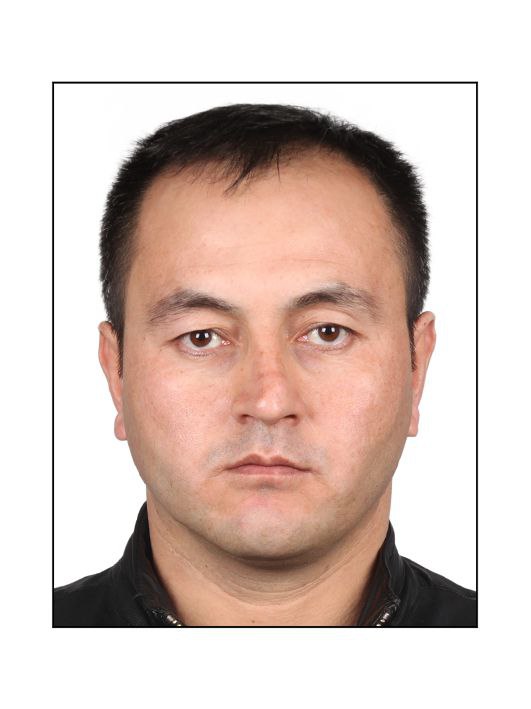
Mr. Naqibullah Asadi Karkin

Educational Background:

  1. ABachelor’s Degree in Information Technology, Faculty of Computer Science, Khatam al-Nabieen (PBUH) University, 2023;
  2. High School Diploma from Sarab Ulya High School, Ghazni, 2017;
  3. Diploma in Networking Fundamentals, Mir Alavi Training Center, Tehran, 2017;
  4. Certificate in Computer User Skills, Tolo-e-Shams Institute, Tehran, 2016.

Work Experience:

  • Laboratory Technician, Faculty of Computer Science, Khatam Al-Nabieen University (PBUH), Spring 2024–present;
  • Website Manager of Khatam Al-Nabieen University (PBUH), Summer 2023–present;
  • Website Designer at Viracloud Company from 2020 to 2022;
  • Marketing Officer at Viracloud Company from 2019 to 2020;
  1. Maintenance of laboratory equipment;
  2. Facilitating the use of laboratory equipment;
  3. Updating, troubleshooting, and resolving software issues;
  4. Hardware troubleshooting and submission of its list to the relevant department for repair;
  5. Attendance during practical sessions and collaboration with instructors who require a laboratory assistant;
  6. Guiding students in the use of equipment and implementation of practical lessons;
  7. Proposal and participation in the procurement of necessary laboratory equipment;
  8. Maintaining and recording academic lesson information in a designated logbook;
  9. Preparation of semester-wise reports on the delivery of academic subjects for the relevant departments;
  10. Preparation of semester-based reports on usable laboratory equipment items for the relevant departments;
  11. Performing other laboratory-related duties assigned by the supervisor as needed;

Curriculum of the Information Technology Department

First Year – First Semester
Course CodeCourse NameCourse TitleCourse TypeNumber of Credit HoursTheoreticalPracticalPrerequisite Course
CS1101Fundamentals of ComputerFundamental of ComputerBasic531None
CS1102Programming Fundamentals (C++)Introduction of Programming (C++)Basic522None
CS1103General MathematicsGeneral MathematicBasic550None
CS1104Electronics 1Electronics I (Fundamentals)Basic220None
CO6101English 1English 1General220None
Islamic Studies 1Islamic Studies 1General210None
Total Courses6Total Credits18153
First Year – Second Semester
Course CodeCourse NameCourse TitleCourse TypeNumber of Credit HoursTheoreticalPracticalPrerequisite Course
CS2201Logic CircuitsLogic CircuitsSpecialized531Fundamentals of Computer
CS2202Programming 1 (Java)Programming 1 (Java)Specialized522Programming Fundamentals
CS1205Electronics 2Electronics 2Basic211Electronics 1
CS1206Linear AlgebraLinear AlgebraBasic330None
CO6203English 2English 2General220English 1
Islamic Studies 2Islamic Studies 2General210None
Networks 1 (Network Fundamentals)Networks 1 (Network Fundamentals)
General521None
Total Courses7Total Credits21165
Second Year – Third Semester
Course CodeCourse NameCourse TitleCourse TypeNumber of Credit HoursTheoreticalPracticalPrerequisite Course
CS2303Programming 2 (Java)Programming 2 (Java)Specialized531Programming 1 (Java)
CS2304Computer ArchitectureComputer ArchitectureSpecialized550Fundamentals of Computer
CS2305Networks 2
Networks 2 (Routing and Switching Essentials)
Specialized531Networks 1 (Network Fundamentals)
CS2306Professional English 1Professional English 1Specialized220English 1
CS1301Discrete MathematicsDiscrete MathematicsBasic330General Mathematics
CO6306HistoryHistoryGeneral220None
Islamic Studies 3Islamic Studies 3General210None
Total Courses7Total Credits21192
Second Year – Fourth Semester
Course CodeCourse NameCourse TitleCourse TypeNumber of Credit HoursTheoreticalPracticalPrerequisite Course
CS2407Data StructureData StructureSpecialized522Programming 1 (Java)
CS2408Operating SystemOperating SystemSpecialized330Computer Architecture
Islamic Studies 4Religions, Sects, and TajweedSpecialized230None
CS2410Professional English 2Professional English 2Specialized220Professional English 1
CS1408StatisticsStatisticsBasic321General Mathematics
CS1409Database 1Database 1Basic522Programming Fundamentals
CO6408Religions, Sects, and Tajweed
Religions, Sects, and TajweedGeneral210None
Total Courses7Total Credits20155
Third Year – Fifth Semester
Course CodeCourse NameCourse TitleCourse TypeNumber of Credit HoursTheoreticalPracticalPrerequisite Course
CS2523Network 3Network 3Specialized321Networks 1 (Network Fundamentals)
CS2514Algorithm Design and AnalysisAlgorithm Design and AnalysisSpecialized330Programming 1 (Java)
CS2512Web DesignWeb DesignSpecialized522Programming Fundamentals
CS2511Software Engineering 1Software Engineering 1Specialized531Professional English 1
CS1410Theory of ProbabilityProbability Theory
Basic330General Mathematics
Islamic Political System
Religions, Sects, and TajweedBasic220None
Islamic Administrative System
Religions, Sects, and TajweedGeneral220None
Total Courses7Total Credits21175
Third Year – Sixth Semester
Course CodeCourse NameCourse TitleCourse TypeNumber of Credit HoursTheoreticalPracticalPrerequisite Course
CS2624Network Programming
Network ProgrammingSpecialized522Programming 2 (Java)
CS2616Web DevelopmentWeb DevelopmentSpecialized522Web Design
CS2626Database 2Database 2Specialized531Database 1
CS2718Data SecurityData SecurityOptional330Networks 1 (Network Fundamentals)
CO6610Environmental studiesEnvironmental studiesGeneral220None
Islamic Economic System
Religions, Sects, and TajweedGeneral220None
Prophetic Biography (Seerah of the Prophet)
Religions, Sects, and TajweedGeneral220None
Total Courses7Total Credits21165
Fourth Year – Seventh Semester
Course CodeCourse NameCourse TitleCourse TypeNumber of Credit HoursTheoreticalPracticalPrerequisite Course
CS2727Network Security
Network SecuritySpecialized531Data Security
CS2728Network 4Network 4Specialized531Network 3
CS2719Research MethodologyResearch MethodologySpecialized211None
CS2720Virtualization
VirtualizationOptional330Operating System
CS2625System Administration
System Administration
Optional531Networks 1 (Network Fundamentals)
Quran and Contemporary Sciences
Religions, Sects, and TajweedGeneral220None
Islamic Social System
Religions, Sects, and TajweedGeneral220None
Total Courses7Total Credits21175
Fourth Year – Eighth Semester
Course CodeCourse NameCourse TitleCourse TypeNumber of Credit HoursTheoreticalPracticalPrerequisite Course
CS2727MonographThesisSpecialized606Completion of at least 125 credit hours
CS2728E-Commerce
E-CommerceOptional220None
CS2719Advanced Networks
Advanced NetworksSpecialized321Network 3
CS2720IT Project Management
IT Project ManagementOptional531None
Islamic Civilization
Religions, Sects, and TajweedGeneral330None
Total Courses5Total Credits18108

Curriculum of the Software Engineering Department

First Year – First Semester
Course CodeCourse NameCourse TitleCourse TypeNumber of Credit HoursTheoreticalPracticalPrerequisite Course
CS1101Fundamentals of ComputerFundamental of ComputerBasic531None
CS1102Programming Fundamentals (C++)Introduction of Programming (C++)Basic522None
CS1103General MathematicsGeneral MathematicBasic550None
CS1104Electronics 1Electronics I (Fundamentals)Basic220None
CO6101English 1English 1General220None
CO6102Islamic Studies 1Islamic Studies 1General110None
Total Courses6Total Credits17143
First Year – Second Semester
Course CodeCourse NameCourse TitleCourse TypeNumber of Credit HoursTheoreticalPracticalPrerequisite Course
CS2201Logic CircuitsLogic CircuitsSpecialized531Fundamentals of Computer
CS2202Programming 1 (Java)Programming 1 (Java)Specialized522Programming Fundamentals
CS1205Electronics 2Electronics 2Basic211Electronics 1
CS1206Linear AlgebraLinear AlgebraBasic330None
CO6203English 2English 2General220English 1
CO6204Islamic Studies 2Islamic Studies 2General110None
CO6205Dari LiteratureDari LiteratureGeneral220None
Total Courses7Total Credits18145
Second Year – Third Semester
Course CodeCourse NameCourse TitleCourse TypeNumber of Credit HoursTheoreticalPracticalPrerequisite Course
CS2303Programming 2 (Java)Programming 2 (Java)Specialized531Programming 1 (Java)
CS2304Computer ArchitectureComputer ArchitectureSpecialized550Fundamentals of Computer
CS2305Networks 1 (Network Fundamentals)
Networks 1 (Network Fundamentals)
Specialized531Fundamentals of Computer
CS2306Professional English 1Professional English 1Specialized220English 1
CS1301Discrete MathematicsDiscrete MathematicsBasic330General Mathematics
CO6306HistoryHistoryGeneral220None
CO6307Islamic Studies 3Islamic Studies 3General110None
Total Courses7Total Credits20182
Second Year – Fourth Semester
Course CodeCourse NameCourse TitleCourse TypeNumber of Credit HoursTheoreticalPracticalPrerequisite Course
CS2407Data StructureData StructureSpecialized522Programming 1 (Java)
CS2408Operating SystemOperating SystemSpecialized330Computer Architecture
CS2409Networks 2 (Routing and Switching Essentials)
Networks 2 (Routing and Switching Essentials)
Specialized531Networks 1 (Network Fundamentals)
CS2410Professional English 2Professional English 2Specialized220Professional English 1
CS1408StatisticsStatisticsBasic321General Mathematics
CS1409Database 1Database 1Basic522Programming Fundamentals
CO6408Islamic Studies 4Islamic Studies 4General110None
Total Courses7Total Credits21156
Third Year – Fifth Semester
Course CodeCourse NameCourse TitleCourse TypeNumber of Credit HoursTheoreticalPracticalPrerequisite Course
CS2511Software Engineering 1Software Engineering 1Specialized550Programming 1 (Java)
CS2512Web DesignWeb DesignSpecialized522Programming Fundamentals
CS2513Database 2Database 2Specialized522Database 1
CS2514Algorithm Design and AnalysisAlgorithm Design and AnalysisSpecialized330Programming 1 (Java)
CS1412Theory of ProbabilityTheory of ProbabilityBasic330General Mathematics
CO6509Islamic Studies 5Islamic Studies 5General110None
Total Courses6Total Credits19155
Third Year – Sixth Semester
Course CodeCourse NameCourse TitleCourse TypeNumber of Credit HoursTheoreticalPracticalPrerequisite Course
CS2615Theory of Automata
Theory of Automata
Specialized550None
CS2616Web DevelopmentWeb DevelopmentSpecialized522Web Design
CS2617Software Engineering 2
Software Engineering 2Specialized531Software Engineering 1
CS3601Wireless Networks
Wireless NetworksOptional321Networks 1 (Network Fundamentals)
CO6610Combating Addiction
Combating Addiction
General220None
CO6611Islamic Studies 6Islamic Studies 6General110None
Total Courses6Total Credits18145
Fourth Year – Seventh Semester
Course CodeCourse NameCourse TitleCourse TypeNumber of Credit HoursTheoreticalPracticalPrerequisite Course
CS2718Data SecurityData SecuritySpecialized330Networks 1 (Network Fundamentals)
CS2719Research MethodologyResearch MethodologySpecialized220None
CS2720Android Programming 2
Android Programming 2
Specialized530Operating System
CS3702Advanced Programming (.NET)
Advanced Programming (.NET)
Optional550Programming 1 (Java)
CS3703Principles of Compiler Design
Principles of Compiler Design
Optional531Data Structure
CO6712Islamic Studies 7Islamic Studies 7General110None
Total Courses6Total Credits17161
سال چهارم – سمستر هشتم
Course CodeCourse NameCourse TitleCourse TypeNumber of Credit HoursTheoreticalPracticalPrerequisite Course
CS2821MonographThesisSpecialized606سپری نمودن حداقل ۱۲۵ واحد درسی
CS2822Mobile Programming
Mobile ProgrammingSpecialized550Programming 1 (Java)
CS3804Project Management
Project ManagementOptional220None
CS3805Data Mining
Data MiningOptional330Database 1
CO6813
Islamic Studies 8Islamic Studies ۸General110None
Total Courses6Total Credits17116

Dean of the Faculty

Phone: +93 728 294 064

Email Address: [email protected]

Head of the Information Technology Department

Phone: +93 749 122 567

Email Address: [email protected]

Head of the Software Engineering Department

Phone: +93 785 727 216

Email Address: [email protected]

Field of Study Current Fee Discount Percentage New Fee
Computer Science 30000 50% 15000
No File Title Download File
1
Faculty Strategic Plan Summary
Scroll to Top