
Achievements and Facilities of the University
Nearly a decade and a half of academic, educational, and research activities at Khatam Al-Nabieen (PBUH) University, along with its steadfast commitment to the motto of “Commitment and Expertise,” unparalleled solidarity, perseverance, and the tireless efforts of its dedicated staff, have yielded lasting results and valuable achievements. These remarkable accomplishments are outlined below.
Key Achievements
- The establishment of the Ghazni branch of the university with programs in Law and Political Science, Economics, and General Medicine in 2012.
- The promotion of Khatam Al-Nabieen (PBUH) Higher Education Institute to Khatam Al-Nabieen (PBUH) University in 2012.
- Obtaining a license and launching master’s degree programs in 2013.
- Inclusion in the quality assurance and accreditation process of the Ministry of Higher Education among three other private universities in 2012.
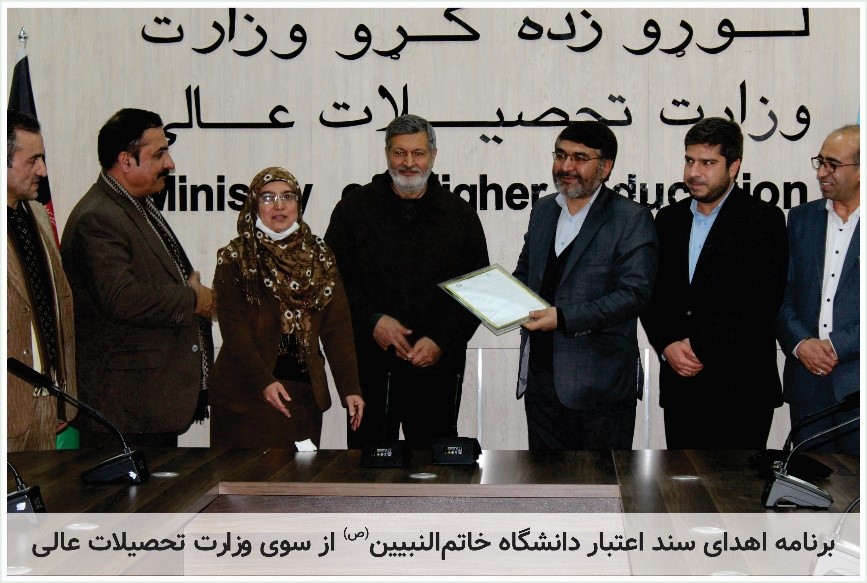
- Attainment of the academic accreditation certificate in the winter of 2020.
- Establishment of the Khatam Al-Nabieen (PBUH) Faculty Hospital in 2015.
- Achieving second place in the quality assurance evaluation by the Ministry of Higher Education in 2016.
- Establishment of a Research and Technology Center with the creation of an animal house for the first time in the country in 2016.
- Publication of more than 33 titles of textbooks and supplementary materials.
- Organizing seminars, workshops, and academic conferences at various university, national, and international levels.
- Publication of 18 ISI articles, 22 ISC articles, and 46 medical research projects.
- Achieving third place in the field of medical sciences in the evaluation by the Ministry of Higher Education and the Presidential Office in 2018.
- Establishing the transplant section in the Khatam Al-Nabieen (PBUH) faculty Hospital in 2018.
- Establishing the Applied Training Center in 2019.
- Establishing the Educational Management System (LMS) at the university level, which is one of the best systems in the country.
- Establishment of the faculty Hospital in Ghazni Branch.
- Support and collaboration in the establishment of Khatam Al-Nabieen (PBUH) Higher Education Institute, Jaghori.
- Khatam Al-Nabieen (PBUH) University, in line with achieving its strategic objectives, has signed 60 memorandums of understanding with various academic and research institutions at the national and international levels, including universities from Indonesia, China, Iran, and India. These agreements focus on faculty and student exchange, experience transfer, knowledge transfer, conducting scientific research, enhancing human resource capacity, offering joint training programs, and other academic matters.
- Scientific Publications: Student journals such as “Asr-e-Information” (Information Age Journal), “Dental Medicine Journal,” “Entrepreneurship Journal,” “Furugh Andisha Journal,” and the postgraduate alumni journals of the university in the fields of “International Relations,” “International Law,” and “Criminal Law and Criminology” are another effort in the noble domain of research. The purpose of establishing and publishing these journals is to promote and develop research among students of all active faculties at the university in the fields of engineering sciences, medical sciences, and humanities.
Scientific Works of University Professors
In addition to providing quality education, Khatam Al-Nabieen University(PBUH) has been able to expand its activities in scientific research and health services to meet community needs. The publication of research articles, printing and publishing textbooks, organizing conferences and scientific congresses are among the university’s research activities, with 499 titles of scientific articles published in domestic scientific journals, 50 titles in international journals, and 42 titles of textbooks in various fields published by the professors of this university. Additionally, more than 500 seminars, conferences, and scientific congresses have been organized by this university to raise public awareness and promote science.
Facilities
Educational, Research, and Administrative Facilities
Khatam Al-Nabieen University(PBUH) has one four-story teaching building with 49 classrooms, two two-story administrative buildings, and several offices totaling over 30 administrative offices. The university also features a hall for meetings and scientific seminars, a library covering an area of 250 square meters, and a parking lot covering one and a half acres.
Modern Hospital
The modern Khatam Al-Nabieen(PBUH) treatment hospital is a complex hospital with 30 beds, officially licensed by the Ministry of Public Health of Afghanistan. It aims to provide standard and unique health services to the community while enhancing the academic and practical capacity of Khatam Al-Nabieen(PBUH) university students and conducting various research projects. In this regard, the hospital has established a kidney transplant department with a local team under the official license and registration from the Ministry of Public Health within its organizational structure. To date, it has successfully performed kidney transplant operations on over 105 compatriots suffering from kidney failure from various provinces of the country, preventing the hardships and exorbitant costs associated with the migration of thousands of sick compatriots. Other services provided by this complex hospital include advanced surgical operations and urology with minimal invasiveness (laser), having a well-equipped internal medicine and cardiology department, performing advanced obstetric surgeries, possessing an advanced laboratory capable of conducting genetic compatibility tests for transplant patients and checking drug levels in blood, having the most equipped and standardized hemodialysis center in the country, as well as a pharmacy rich in rare medications and medications for special patients.
Laboratories
The university has various laboratories as follows:
- Medical Laboratories: 14 laboratories in different departments;
- Engineering Laboratories: 5 laboratories for students in Civil and Electrical Engineering;
- Computer Science Laboratories: 2 computer labs and a dedicated CISCO lab;
- Animal House (Animal Laboratory);
- Research Center.